

Senate Estimates: Quick Brief—Day Five
Day Five is the capability, workforce, and structural dependency day.
Week Two opens with four committees sitting simultaneously across four of the most consequential policy domains in the Budget: Australia has committed to a defence and industrial posture more ambitious than anything it has attempted in the post-Cold War era, and the human and material inputs that posture requires are under concurrent pressure.
The Foreign Affairs, Defence and Trade Committee (FADT) carries the defence and AUKUS accountability threads developed last week, now applied to Defence, the Australian Submarine Agency, and the Australian Signals Directorate—the agencies that must answer for the arithmetic of strategic insolvency.
The Economics Committee (EC) carries the NRF, CSIRO, Treasury, and the RBA—the institutions responsible for the productive investment claim on which the Budget stakes its fiscal path.
Education and Employment (EE) carries the skills and compliance questions that connect directly to the Budget’s productivity assumptions and its treatment of small business, and the industrial relations settings governing a defence effort already under pressure and at risk of cost over-runs.
Community Affairs (CA) carries aged care and the algorithmic welfare system.
The brief is structured around meta questions for each committee, with targeted lines where the evidence base from the source articles and prior briefs is specific enough to demand it. Week Two is where the fiscal tests the Primer identified—integrity, structure, strategy—are most directly answerable. The standing strategic questions, operational questions for senior executives, and the QON/NFP/DTBNYA accountability framework from last week remain live.
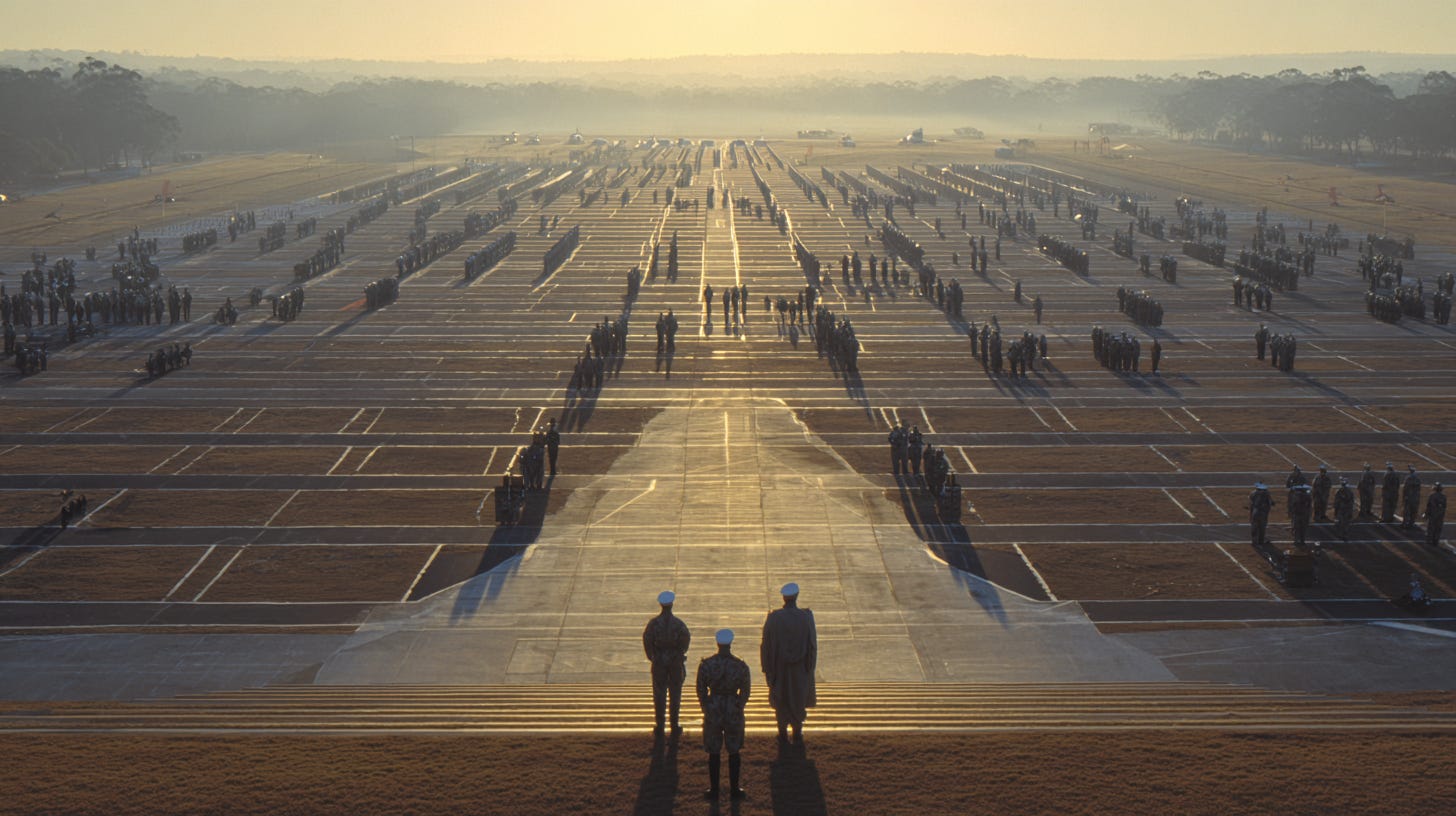
Tuesday 2 June — Committee Schedule
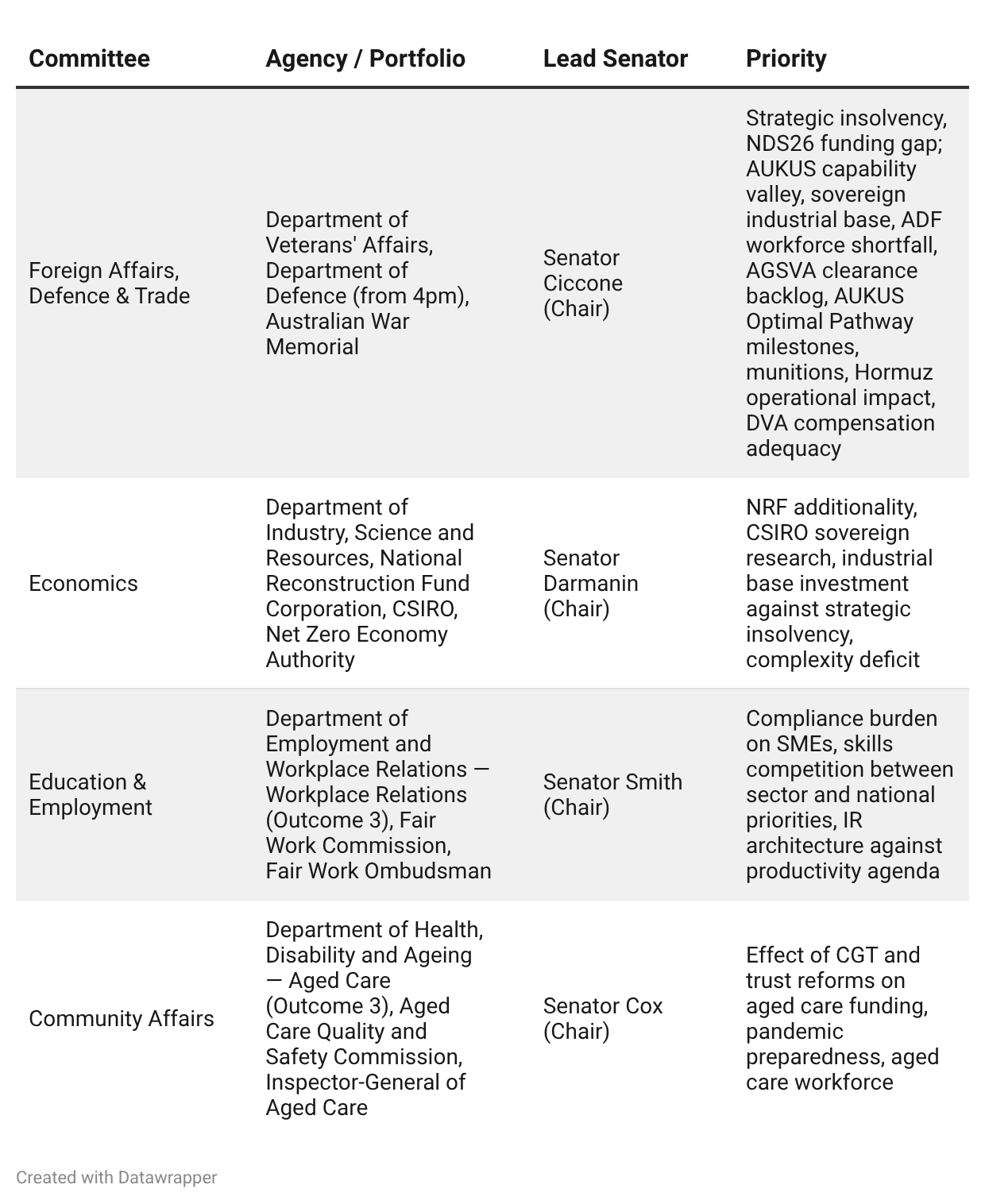
COMMITTEE 1 | Foreign Affairs, Defence & Trade
Department of Veterans’ Affairs; Department of Defence; Australian War Memorial
Appearances: DVA 9.00am–1.00pm; AWM 2.00pm; Defence from 4.00pm (extending to Thursday)
Strategic Context
The analytical framework for this committee’s week comes from earlier work read together. First, in ‘Australia Strategic Insolvency’ we argue that Australia’s commitments have outrun the means allocated by government, and the US security guarantee that made that gap tolerable is being structurally renegotiated. Second, ‘The Budget Maths of Exposure’ documents the specific arithmetic: Defence spending at 2.02 per cent of GDP, $15.2 billion in unreconcilable claimed new funding, $135 million in defence industry support against an industrial base that needs transformation, and a capability valley—the gap between Collins’ effective service life and genuine replacement—that the Budget fails to close. Third, ‘The Unresolved Tension’ identifies the structural contradiction at the heart of NDS26: the strategy proclaims self-reliance while every capability in it runs through Washington. Last, ‘What’s a Peripheral Middle Power to Do’ adds the systemic analysis: Australia’s hub-and-spoke dependence means the system’s resilience is a function of hub reliability, and the hub is behaving unpredictably.
Defence will resist spending three days being asked whether the strategy is funded. The more productive accountability questions are operational and administrative: which specific capability milestones are funded to completion within the forward estimates, which are aspirational, and who is accountable if they are not achieved. These are answerable. They put the gap on the record without requiring Defence to concede a position it will never concede voluntarily.
