

Senate Estimates: Quick Brief—Day Three
An analytically dense day.
Day Three is the most analytically dense day thus far. Finance and Home Affairs carry between them the fiscal architecture of the Budget, the governance of the Commonwealth’s most consequential long-term program, and the expanding boundary of executive power over digital infrastructure, public information, and citizen data. The e-Safety Commissioner, appearing in the Environment and Communications Committee in the afternoon, connects both. The Australian Public Service Commissioner, first up, has stewardship over the capability and integrity of the APS.
The standing strategic questions, operational questions for senior executives, and the QON/NFP/DTBNYA accountability framework from Brief #5 remain live across the full two-week period. And they lie within Finance’s remit.

Wednesday 27 May—Committee Schedule
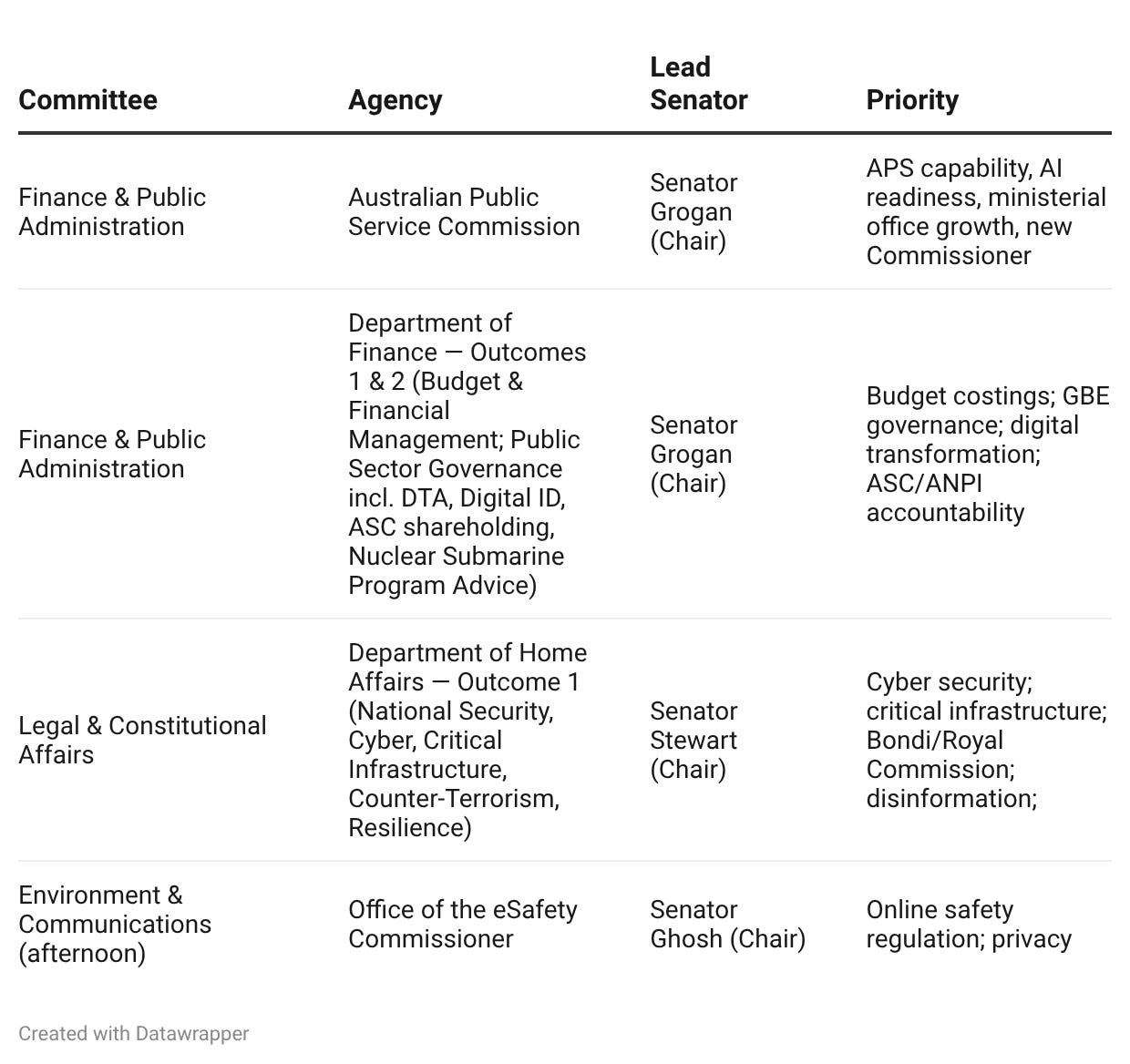
COMMITTEE 1 | Finance & Public Administration
Australian Public Service Commission — Senator Grogan (Chair)
Appearance: Wednesday 27 May, 9.00am (concurrent with PM&C/Office for Women/WGEA from 10.45am)
Strategic Context
A new APSC Commissioner has been appointed into one of the most difficult environments the APS has faced in a generation. The APS is managing the accelerating uptake of AI without consistent governance frameworks, a skills and capability deficit that officials privately acknowledge but portfolio statements rarely quantify, and a structural shift of real policy work into ministerial offices—an expansion explicitly visible in the Budget’s resourcing of ministerial support, and implicit in the quality of the Budget itself. The APSC’s function is to lead and promote best-practice public administration. On Wednesday, the committee should test whether the Commission is doing that or managing the optics of it.
The tension is structural, not personal. Politicians have always preferred trusted advisers in their own offices. But when policy is predominantly made in ministerial offices rather than departments, the public service loses the institutional knowledge and contestability that makes government work—and the Australian public receives worse outcomes over time. The Budget’s ambitions—$10.2 billion in regulatory reform savings, NCP productivity gains, AI-enabled efficiencies—all require a capable, coherent APS to deliver. The APSC’s own assessment of where that capability actually sits is the most important thing it can say on Wednesday.
Priority Lines of Inquiry
New Commissioner — mandate and diagnosis. At a time when the APS faces documented capability pressures across AI literacy, specialist policy skills, and workforce planning, what is the Commissioner’s own diagnosis of the three most significant capability gaps in the APS as at May 2026—not themes, but specific, measurable deficiencies? And what is the Commission’s plan to address them within the forward estimates?
Ministerial office growth and policy displacement. The Budget includes increased resourcing for ministerial offices. The number of ministerial staff has doubled since the Howard government. Has the APSC assessed whether the growth of ministerial office capacity is displacing departmental policy development—and if so, what is the consequence for the quality and contestability of advice reaching ministers?
The APS Act places obligations on secretaries to provide frank and fearless advice. If policy is increasingly being developed in ministerial offices rather than departments, who is responsible for ensuring that advice remains frank, evidence-based, and contested before it becomes a decision? (Note: the APSC has published on the relationship between offices and department—but it is a description of best case, not an assessment of quality or consequences.)
AI capability and governance. The Budget’s productivity assumptions are partly dependent on AI-enabled efficiencies across the APS. The ANAO’s February 2025 audit found the ATO’s AI governance only partly effective. What is the APSC’s current assessment of AI literacy and governance capability across the APS—not as a self-reported framework exercise, but as a demonstrated operational readiness? Which agencies are furthest behind, and what is the Commission’s plan for them? (Note: DTA and Finance are responsibility for ensuring the use of AI in government; the APSC uplifts capability and has a responsibility for the capability and integrity of the APS as a whole.)
Skills, retention, and the ‘good people holding it together’ problem. APS workforce data shows persistent attrition in specialist roles—economists, data scientists, regulatory experts, engineers. What is the current vacancy rate in these categories, what is the median time-to-fill, and what is the Commission’s assessment of whether the APS remuneration framework is fit for purpose in competing with the private sector for these skills?
Department of Finance — Senator Grogan (Chair)
Appearance: Wednesday 27 May, 12.00pm–11.00pm (Outcomes 1 and 2; extended all-day session)
