

Technologies at the Frontier: AI and Data Centres
Australia's recent shift in approach to AI has some layers that need adjustment.
Australia is betting its AI future on concrete, racks and cooling systems, while the real value—the IP, the models, the standards—walks out the door. Data centres are part of the underlying infrastructure but of themselves insufficient for Australia to secure its economic and technological future.
After considering Australia’s approach, centres of value and interdependence, we propose that Australia engage in ‘bridging’ between the two main Western regulatory approaches.
Australia’s Approach
Australia has quietly abandoned its AI regulatory ambitions. In 2024, Australia focussed on developing mandatory guardrails for artificial intelligence, following in the footsteps of Canada and the European Union1. But since the return of President Trump, and with Australia’s productivity anxieties2, the stance has flipped. The government now favours evolving existing laws over the introduction of new, proscribed guardrails. And in the December 2025 National AI Plan there is a clear shift towards physical infrastructure rather than the development of AI models, and a bid for A$100 billion in private investment for data centres.
The preference for infrastructure over models and software seems to be based on:
copyright protections. The government’s October 2025 decision to explicitly reject a text or data mining (TDM) exception for the Copyright Act 1968 means that local AI developers will need to negotiate (expensive) licensing deals. Both the United States and European Union have more flexible arrangements, aiding AI model development and growth; and,
data sovereignty concerns. Australia’s leaders view the development of domestic data capacity as critical to retaining control of sensitive data and are betting that control over the base infrastructure itself can act as a ‘safe harbour’ for data, even while utilising software and AI models developed overseas.
Australia’s Data Centre Activities
There is a logic to Australia pursuing data centres, not simply from the perspective of foreign investment into cash-strapped economies and job creation (an ever-present focus of ministers). Data centres serve as part of the underlying layer of the interconnected cloud intrinsic to modern economies, societies and security apparatus. Australia is clearly aiming to position itself as a host for regional data infrastructure and regional AI computing.
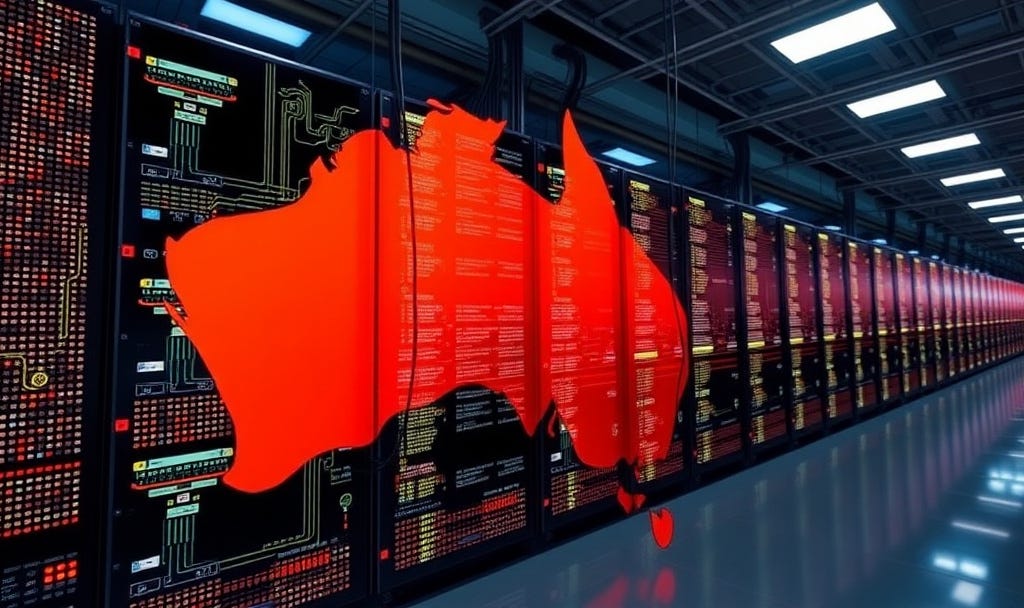
Australia’s positioning has already enabled some hyperscale companies3 to commit expanded investment. Even preceding the public policy pivot, in June 2025, Amazon Web Services (AWS) invested AU$20 billion over four years to expand its data centre footprint in Sydney and Melbourne.
Microsoft announced back in late 2023 that it would be investing $5 billion into expanding Microsoft data centres in Australia, adding nine new sites in Canberra, Melbourne and Sydney. A year later Microsoft announced it would also be contributing to data centre expansion in Western Australia.
Google is in talks to build a data centre on Christmas Island. That, however, part of its larger efforts to expand a subsea cable network between Australia—especially the more disconnected west—and other nations across the Indian Ocean.
As for ‘second tier’ providers, AirTrunk4 announced a second data centre campus in Melbourne in December 2025, estimated to cost over A$5 billion, and bringing its total investment in data centres in Victoria to over $7 billion. NextDC, announced a partnership with OpenAI early December 2025 to develop and operate a ‘hyperscale AI campus and large-scale GPU supercluster’ in Sydney, at a cost of over A$7.5 billion.
Canberra Data Centre (CDC)—which hosts much of Australian government data—is investing A$2.7 billion into a second Melbourne campus, having just officially opened its first, and its proposed A$3.1 billion data centre campus in Marsden Park, Sydney, received approval in November last year5.
But data centres are only one part of the digital infrastructure ecosystem, let alone the AI stack.
What’s missing
To illustrate some of the issues, we’re drawing on Mariana Mazzucato, and her treatment of value6; and on Henry Farrell and Abraham L. Newman’s 2019 article, ‘Weaponized Interdependence’7. Neither of these perspectives will map directly on to the problem, but they provide useful lenses for analysis.
Value creation and/or value extraction?
Mazzucato’s core distinction is between value creation and value extraction:
Value creation means generating new productive capacity—skills, IP, compounding capability, the ability to set terms for others; while,
Value extraction means capturing returns from value created elsewhere, without contributing to the conditions that make it possible.
Applied to computing infrastructure and AI, this distinction has a specific shape. The assets that generate lasting value are not physical—they are the IP embedded in chip architectures, the proprietary weight of trained models, the data that improves them, and the standards that govern how they are built and used. Physical infrastructure—land, buildings, power, cooling—is a necessary condition for these assets to exist, but it is not itself the source of value. It depreciates. The assets above it in the stack compound.
So the question for Australia is not whether AI infrastructure sits on Australian soil, but whether Australia holds any of the assets that compound—and whether its current approach creates conditions for it to do so.
The Physical Infrastructure Stack
One could easily conclude that Australia’s approach to the infrastructure of data centres and high compute is extractive, with others setting the price and taking the returns.
The GPU (Graphics Processing Unit) dependency dynamic is illustrative of this point. It is hard to fault Australia for not building a competitive GPU fabrication capability—it is an extraordinarily difficult technology to start or scale, especially for cutting edge delivery and AI. But while Australia’s move to bring in large-scale infrastructure will build capacity, it will still be reliant on overseas GPUs; taking that supply for granted lowers immediate monetary cost but loses out on potential value elsewhere8.
So while Australia’s efforts to establish domestic hosting of data centres with massive foreign investment and hardware is a functional first step, it still leaves a lot of the more meaningful implications on the table—and there is not a larger, longer-term vision apparent, or a willingness to engage in the ecosystem discussion.
This observation only becomes stronger when we move to consider the wider AI and data stack.
The AI and Data Sovereignty Stack
Simplifying the more complete data, computing and AI ecosystem into smaller segments illustrates where Australia misses out on a wider spectrum of value.
Data as a productive asset. Australia’s positioning for infrastructure means that data within Australia’s growing digital ecosystem will be used to improve overseas AI models and software. Australia is building an arrangement to host the data and the model usage, but those will feed further value into AI models that are retained by overseas AI companies;
Algorithmic IP and the loss of assets. Australia’s step back from AI models and research is not a one-time transfer of value loss for Australia. It is the foreclosure of future compounding assets in a highly competitive area of emerging technology. This approach also has an inhibiting effect on Australia’s ability to domestically strengthen and expand its talent pool and a credible research base.
Regulatory and standard-setting influence. The United States and European Union are establishing the governance frameworks that are determining how democratically born AI is built, deployed, audited and traded. Australia is a rule-taker on the regulatory level as well as the hardware level.
Australia is trading short-term strategic determinism in a vital area of technological and strategic development to build infrastructural capacity. But given that nature of AI research and development, there remain opportunities, including for rebalancing dependencies.
Interdependence and Risks
Farrell and Newman’s framework of weaponised interdependence illuminates the dynamic. The logic of interdependence, specifically the ability to exclude actors from dollar-clearing systems and to monitor flows through US-routed internet infrastructure, also applies to AI. Interdependence is not symmetric, and the question of who can turn off access to whom is not simply commercial, but political.
Australia’s current approach makes it a ‘node’ dependent on ‘chokepoints’ that, while held ostensibly by an ally, have already been used, specifically against China—and with the Pentagon’s exclusion of Anthropic, one of its own. The United States’s growing restrictions on advanced semiconductors and chips in the last few years display a leverage that Australia cannot match and that could very easily wrongfoot Australia. Given what Australia is giving up to achieve mass data centre capacity—model independence, and significant regulatory and operational control over sovereign data centres—Australia’s already limited leverage weakens further.
The reality, however, is that no country has enough of the materials—whether its intellect, resources, software or hardware—to genuinely pursue sovereignty over artificial intelligence9, although the United States naturally stands as best positioned due to previous decades of high technology depth at scale. But even beyond this there are greater risks to Australia’s digital infrastructure position across the broader spectrum of affairs.

Broader ecosystem risks
We’ve not yet covered three other matters that make data centres so contentious and may yet undo even Australia’s currently limited ambitions.
Competition. Australia is not the only country to realise the potential opportunities that come with a massive uplift to data centre capacity. Malaysia is undergoing its own data centre boom, fuelled by cheap, plentiful, reliable energy10. President Trump, through Project Stargate, is investing up to USD$500 billion in Texas (which offers tax exemptions for data centres) to bulwark US AI dominance. Australia needs its own clear competitive offer—preferably in line with its own domestic standards and strategic goals.
Energy. There are multiple issues here: renewable energy dependence on China, the energy transition gap, and domestic political sensitivities over rising electricity prices. The Australian government’s renewable energy sales pitch covers over its increasing dependence on China—at a time of increasing geostrategic tension—for solar panels, systems and batteries. Australia’s pursuit of fossil fuel power plant closure creates a gap between expanding energy requirements, including from energy intensive data centres side, and reducing energy grid sovereignty11. Data centres are increasingly unpopular in local communities, in countries from the United States, to the Netherlands and Singapore, because of the pressure they bring on energy, water and land12.
Targeting. In the last few days, Iran has included regional data centres in its targeting in response to US and Israeli attacks. Reports suggest two successful strikes on AWS data centres in the United Arab Emirates and Bahrain. Digital infrastructure will be targeted during both hybrid or grey zone warfare—consider Russian attacks on underseas cable in the Baltic and the prepositioning of malware in utilities and infrastructure by China—as well as during ‘hot’ war. Growing digital and data centre capability, especially as a ‘regional centre’ will offer a valuable target for adversaries.
The bridge no-one is building—yet
The opportunity here for Australia is structural. The United States and European Union are developing fundamentally different approaches to AI and seemingly have little interest in devoting effort to compromise directly with each other. That’s creating increasing friction between the differing regulatory approaches, with other jurisdictions finding it hard to both host the infrastructure and credible adherence to both frameworks. The hyperscalers are increasingly aware of this issue, and don’t want to devote themselves to one approach and voluntarily limit their market.
Taking advantage of the ‘bridge’ opportunity is enticing. Australia could develop long-term compute capacity, driven by tough problems in science, government and industry, make itself invaluable to existing allies beyond its natural resources, and nuance a situation where it could selectively benefit from both approaches. There are two key angles to explore in this ‘bridge’.
First, the divergence between US and European approaches to AI—one for scale and general capability, the other for focused execution within governance constraints—creates an opportunity for Australia. It could offer neutral ground, enabling interactions between the two approaches with less risk of the other’s legal and regulatory context butting in13. Both sides can benefit from exposure to the research and scalability the other is practicing, as well as how models could benefit from deliberately integrated architectures in the future.
Second, this environment could be extended to Australia’s allies and partners in the Indo-Pacific, so achieving with more coherence and depth government ambitions than the current approach allows. It would help strengthen the relations and capabilities between like-minded allies and partners, lending greater substance to arrangements that would otherwise rest simply on security ties. Digital infrastructure and AI is fundamental to the economic and social fabric: doing it well, bridging between alternate approaches, and offering an alternate, stable centre for compute—and not just for concrete and cooling—would benefit regional resilience.
But to exploit such an opportunity, Australian leaders must consciously choose between passive dependency and active positioning—no nation is truly independent on AI, and the ‘independency vs dependency’ choice has already been made by countries pushing the pace of frontier AI development elsewhere. Australia’s window for ‘bridging’ will not remain open forever—other nations are already seemingly more aware of it than Australia is—and it requires a credible domestic capability floor (energy, resources, government and commercial investment) that Australia is largely failing to identify, let alone support.
Conclusion
As we’ve argued elsewhere, Australia needs a vision of the future that is more than simply jobs, foreign investment and media releases. ‘Bridging’ offers a viable middle path for Australia, both to navigate between competing regimes and as a means of Australia building a capability that is more than land and digging digital data. Given the divergence of world view, investment and regulatory regimes, Australia needs to act sooner rather than later, before the window is closed.
Both Canada’s and the European Union’s plans for adjusting legislation for AI—more specifically ‘high-risk’ AI—were directly referenced in the Department of Industry, Science and Resources (DISR) consultation process and proposal paper.
In August 2025, Australia’s Productivity Commission’s interim report called for a pause on economy-wide AI regulation to avoid stunting AI development and adoption into Australia. Both the Productivity Commission, as well as key members of the Albanese Government have aired their thoughts that AI is key to boosting Australia’s plateaued productivity rates.
Companies that are considered ‘hyperscale’ are those that can deliver the full stack of hardware, infrastructure and servers to build a distributed computing environment into thousands of servers. The likes of Amazon, Microsoft and Google are the obvious standouts.
AirTrunk was recently acquired by a consortium led by Blackstone and the Canada Pension Plan Investment Board (CPP Investments) in a deal worth over AU$24 billion. The company remains under the leadership of its founder, Robin Khuda, and headquartered in Sydney.
CDC’s Marsden Park campus is planned to be the southern hemisphere’s largest data centre, with 504 megawatts just being the initial plans and the potential to scale up to 1 gigawatt.
More specifically, Mazzucato’s thinking in her book, The Value of Everything, where she looks at the economic value gained from extractive versus productive society models. Mariana Mazzucato, The value of everything: Making and taking in the global economy (Hachette UK, 2018).
Henry Farrell and Abraham L Newman, “Weaponized interdependence: How global economic networks shape state coercion,” International security 44, no. 1 (2019). The authors consider how the United States uses its centrality in global financial and information networks as coercive leverage.
GPUs are not a one time purchase—at current rate high quality GPUs in data centres supporting AI burn out within three years, so there is an ongoing cost there. But Australia also misses out on other areas of industrial value by taking GPU buying for granted, namely the lack of industrial or manufacturing knowledge development that could come with fabrication attempts, even at a non-competitive level, and the lack of influence over regulatory standards, which goes on to affect their ability to affect regulatory change at the software level.
This is also likely part of the reason why the ‘AI bubble’ amongst the big tech companies all keep funding each other—even the leading companies aren’t necessarily able to work independently of each other. They co-evolve.
Between January and October in 2024, Malaysia attracted around USD$32 billion in investment from hyperscalers.
The increasing supply chain vulnerability from dependence on China for solar cells and batteries—both core to Australia’s renewables—is exacerbated by cybersecurity concerns. Neither promote Australia as being the reliable, safe and secure haven for data centres that the government promotes.
Water, used to cool data racks, is an issue as well, but may be able to be better managed, as, for example, through use of oil immersion cooling.
CERN offers a model for this approach: it is neutral ground for the major high-computing companies, who are enticed by the prospect of testing their equipment on one of the toughest scientific problems in physics.