

The IBCC Stable Door
Treasury has been consulting on a concession to a reform that is already law.
Treasury’s consultation on the Innovative Business CGT Concession—the carve-out meant to shelter innovative start-ups from Australia’s new capital gains regime — closed on 10 July. The regime the concession is meant to soften became law on 26 June. The prior general 50 per cent discount is gone, replaced by cost-base indexation and a 30 per cent minimum tax, legislated and assented to before the consultation on its own exception had closed.
The horse has bolted. We are being consulted on the stable door.
I have written before about the ritual of asking—consultation conducted after the decision, as ritual rather than input. This is perhaps the harshest example yet.
Still, many of us took the invitation seriously, because the instrument on the table is revealing. The purpose of a system is what it does, not what its preamble declares1. And what the concession does, in every design choice, is contain.

Containment, not ignition
Let’s look at the language. Caps. Gates. Elections. Holding periods. Lifetime limits. A recurring refrain of ‘the Government will consider’. This is the language of an institution managing leakage from a scheme it has reluctantly permitted, not one trying to make something happen.
The consultation paper’s own evidence points the other way: young firms generate around 60 per cent of new jobs; innovative firms carry a productivity premium of roughly 45 per cent above industry average; the paper concedes significant spillover benefits and a globally mobile ecosystem. It then sets ‘broadly asset neutral’ treatment as the benchmark. That is, the tax system should favour no asset class over another. That may sound like prudence. But neutrality is the right benchmark only when the investor captures the full return.
Start-up returns do not work that way. The jobs, the productivity gains, the spillovers land largely on people who never held a share; the founder and her backers bear all the risk and capture only part of the reward. Under a ‘neutral’ tax system they will therefore do less of it than the country needs—not from timidity, but from the maths of risk versus reward.
Where the social return exceeds the private one, the standard response is to tilt the settings toward the activity, not to tax it back to level. An instrument aimed at neutrality, for an activity the same document agrees generates outsized social returns, is arguing with itself. The burden of proof runs the other way: not ‘why should the state concede revenue on these gains?’ but ‘why is the state taxing away an activity it agrees the country needs more of?’
The deeper failure is a misunderstanding of how the system being taxed actually works. Venture returns are not normally distributed; they follow a power law. A handful of outsized successes generate almost all the jobs, productivity and spillovers the paper celebrates, and that handful cannot be identified in advance2. This is not a defect of the ecosystem, that’s what it does: a start-up ecosystem is a discovery mechanism. It generates variation, lets the selection environment do its brutal work, and amplifies the rare survivor. Policy cannot pick the winners; it can only shape the environment in which they emerge.
Judged that way, the design pulls precisely the wrong levers. The $10 million cap does nothing to the median outcome and everything to the tail. Once the cap is crossed, the harshest treatment in the new regime is reimposed on exactly the firms the concession exists to relieve. The instrument abolishes itself at the moment of success.
The five-year holding period commits a subtler error. Patience is a property of investors; a lock is a constraint on outcomes. A trade sale in year three is a success—the fast, high-multiple outcome the whole apparatus is meant to reward—and the lock punishes it. Worse, it stalls the flywheel on which every mature ecosystem runs: successful founders and early employees exit and become the next round’s angels, mentors and founders. In a small, capital-scarce system, the velocity of that recycling matters more than the duration of any holding. The lock slows the two scarcest inputs—experienced founders and early capital—through the system it claims to feed.
Then there is who can actually use it.

Filters and gates
Complexity is not a neutral drafting artefact; it is a regressive filter. A concession that requires professional advice to price is a concession delivered to the well-resourced and denied to the garage-stage founder it claims to serve.
The subjective innovation gate sharpens the effect. Its real cost is not the occasional wrong call but the deterred attempt: an investor cannot value a benefit whose availability turns on how an official will later characterise the firm, so the rational response is to discount it to nothing.
The gate will also be administered against growth, because its error costs are asymmetric—wrongly admitted firms are visible and auditable; wrongly excluded ones simply never raise, never scale, or leave. The irony is that a back-ended concession is self-selecting: firms that fail claim nothing, so the only fiscal exposure is on the winners the state says it wants.
The design could afford generosity at the door. It borrows caution instead.
The blind spot with the highest strategic price is software. Most start-ups are, at their core, software companies; AI is software. Yet the R&D Tax Incentive’s experimental-science test systematically screens out the integrative, architectural uncertainty that constitutes most real software and AI engineering, and the new concession inherits that defect by reference. Meanwhile the R&DTI re-targeting turns the early-stage cash tap down from 20283, while the concession pays only at exit. A software founder is offered neither timely support nor timely upside — in the sector on which future productivity and sovereign computational capability most depend.
Here the tax question becomes a strategic one. Australia is capital-scarce and a long way from the deep pools of venture money. The distance starves us: capital does not have to come here, and founders do not have to stay. Weak accumulation paths push firms — and the intellectual property they create—toward the America’s small-business stock exemption, British reliefs, Canada’s lifetime exemption. What follows the founders offshore is the IP, the profits, and eventually the tax base itself, hostage to foreign boards and transfer-pricing decisions.
Strategic consequentiality
Capital gains settings are a sovereignty instrument, not merely a fairness lever.
Citizens asked to comment on a design whose consequences only one party can see, after the decisions that matter have passed into law, is another means of containment. Treasury and the Parliamentary Budget Office hold the microdata and the behavioural models. The consultation paper publishes no costing, no estimate of the qualifying population, no distributional analysis, no behavioural modelling, no sensitivity testing. Legislate first, consult second, on models the public cannot compute and data it cannot see, contain the prospect of debate and for alternatives, over-ride objections4: each instance seems small, and each corrodes a little further the trust on which the legitimacy of taxation rests. Legitimacy is built through process—and spent through it, too.
Tax instruments encode a theory of the society they build. This one prefers consumption to accumulation: it closes another wealth-building vehicle while the principal-residence exemption stands untouched. The message to talent and capital is not ‘build an enterprise’ but ‘buy a house’. It rewards the employee over the entrepreneur and invests in the floor while dismantling the ladder—and a floor without a ladder must still be funded, by the very climbers the architecture discourages. That is a fiscal contradiction, not merely an ideological preference.
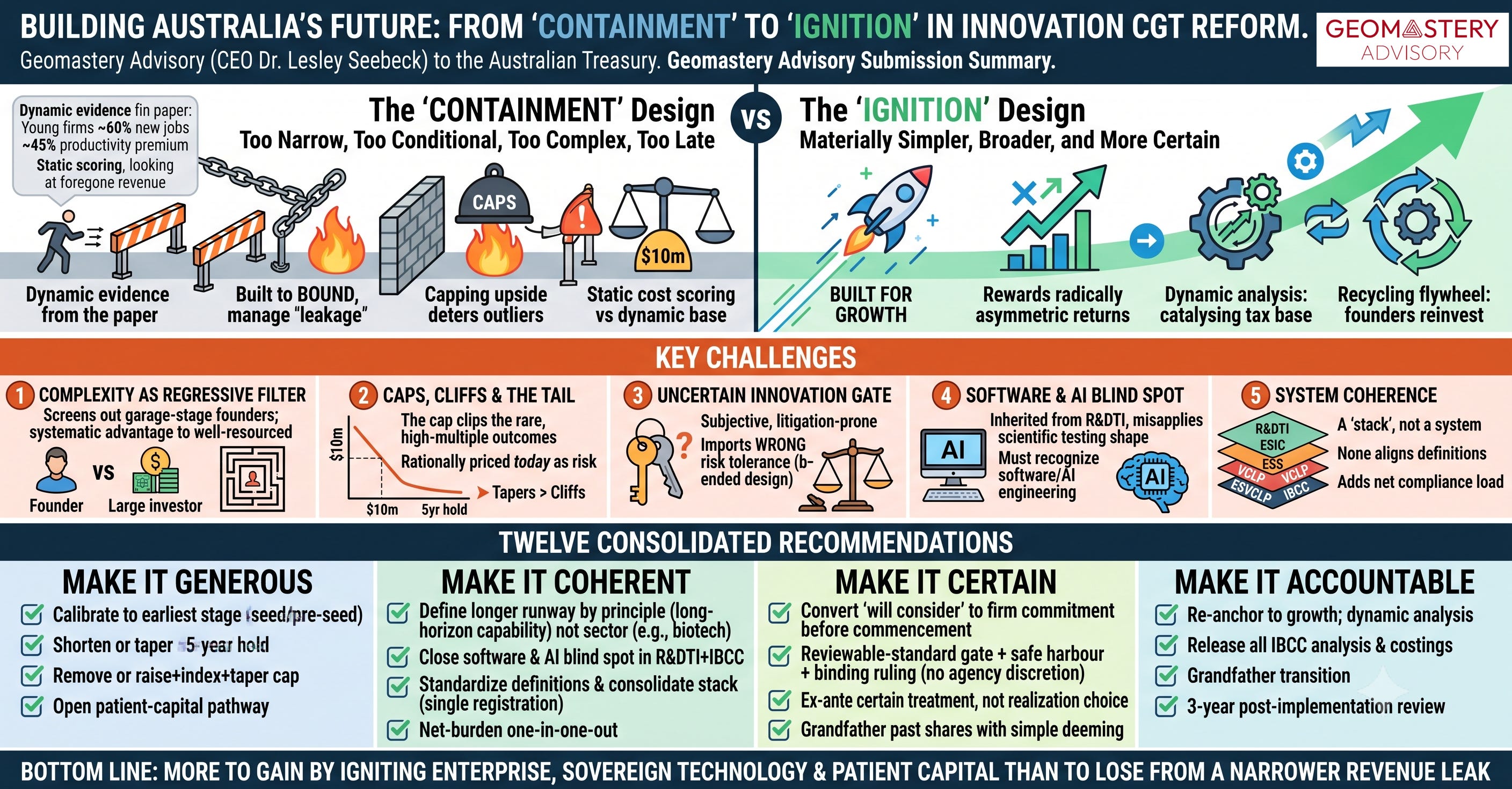
The choice before the government is between an economy that ignites enterprise and one that contains it. The fix is to make the concession more generous, more coherent, more certain, more accountable and that stops adding compliance load to those least able to bear it. This instrument, and the reform it patches, chooses containment. It need not.
This post draws on Geomastery Advisory’s submission to the consultation. I am the company’s CEO and co-founder; interests are declared there. The following illustration, via Gemini, captures the gist of the full submission.
Stafford Beer’s heuristic of the purpose of a system is what it does, or POSIWID, which I have applied to defence policy and government’s policy on universities.
Which brings into question the whole ‘innovative’ start-up definition, as well.
It’s not clear that there was cross-consultation between Treasury and DISR on the Ambitious Australia report and its recommendations, and the consequences of the CGT changes.
Treasury does not host submissions to the consultation paper (or any of its other consultation papers) on its website, so we have no indication as to how many were submitted.