

Universities as democratic infrastructure
The two functions democracy needs are those for which nobody pays.
In The Instrumental University, I arrived at the conclusion that, following Stafford Beer’s heuristic, the purpose of a system is what it does (POSIWID), the Australian government saw universities as instruments of the economy, and increasingly in the context of national security.
But on a reread of the Universities Accord, it becomes clear that there are two theories of the universities held in tension. One is the economic utilitarian view, most clearly aligned with the POSIWID analysis. The second is civic/humanist point of view, in which a university’s value derives from personal transformation and an idea around education for democratic health. The imposition of HECS fees is in part a response to the first part of the second point of view, which aligns a student’s payments with the ‘personal transformation’ fees incurred.
That begs the question of what is ‘education for democratic health’—and who pays for and takes responsibility for it.
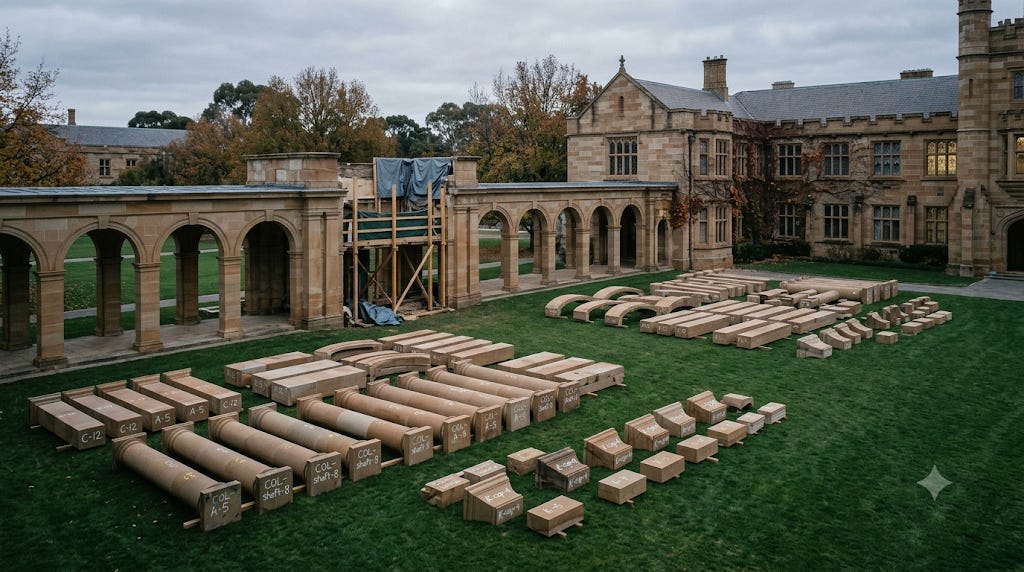
What makes a university a university
Let’s start with the functions of a university. Essentially, universities do five different things, which tend to get bundled together:
Credentialing: sorting and certifying people for the labour market. This is the dominant revealed function by revenue and by student motivation. It is also almost entirely not the democratic function. A credentialing machine can run under an autocracy perfectly well.
Mass skilling: producing a workforce. Again, regime-neutral: China does this superbly, for example.
Knowledge production: research, including the slow, useless-until-it-isn’t kind. Partially democratic, because independent expertise checks power and university may be able to support long-term, fundamental effort, but also done in national labs and companies, especially at the applied and development end, which governments are emphasising.
Custody of contested knowledge and of independent expertise: the capacity to say true things that powerful actors don’t want said, with enough institutional armour to survive the pushback. This is load bearing for democracy.
Formation of a civic class: habituating people into argument, evidence, disagreement-without-violence, tolerance of ambiguity. This is the claim made by John Stuart Mill in 1867, and by John Dewey in 1916. Harder to measure, easier to assert. Also load bearing for democracy.
Under stress, these decouple. For example, take away the independence, and you get a government research body, an industry research lab or a think tank (meeting their paymasters’ interests). Take away the scale and you get lone, or fragmented groups of dissidents. Take away the longevity, and you get a journalist’s scoop. Takeaway the production of new knowledge, and you get a court or a guild.
It is the combination of independence plus knowledge-generation plus scale plus longevity that is the university’s structural distinctiveness.
It is the university’s habituation function—its ‘soft tissue’— that is really under pressure, and not simply from the instrumentality of state and its mechanisms. While democracy needs the skills enabling the holding of a position while being contradicted, distinguishing argument from identity, and treating disagreement as normal, it is exactly what can be destroyed by partisan politics, let alone the mob. The structure that would produce it—sustained argument among people who disagree, under norms of evidence—exists on paper but is under attack from two directions: ideological homogenisation of faculty (fewer real disagreements to model) and the credential-instrumentalism of students (focussed on getting a degree, for which they are paying).1
Actors and interests
Let’s now turn to the actors and interests, because ‘universities are good for democracy’ is a values claim.
The state / incumbent power. Stated interest—see its policies, speeches, statements. Revealed interest: wants expertise it can cite when convenient and ignore or discipline when inconvenient. Not neutral toward independence —actively ambivalent. Funds the university, therefore holds a lever, therefore the independence is always conditional. This is the central antagonist, an actor with a working incentive.
Faculty. Stated interest: truth, academic freedom. Revealed interest: status, autonomy, and job security, which sometimes aligns with truth-telling and sometimes aligns with conformity to whatever their in-group rewards. Should not be romanticised: tenure (where available) is a structural protection precisely because you can’t rely on individual courage.
University administration. Revealed interest: institutional survival and revenue. Academic freedom is a cost, as it generates political risk and funding friction. They will defend it rhetorically and abandon it quietly when a controversy gets expensive.
Students. Revealed interest: overwhelmingly the credential. Civic formation is a byproduct they didn’t ask for and often resent being raised.2 Recall that with HECS and fees, their own economic interests are tightly harnessed to successful completion of degree programs.
The public. This is the party with the strongest interest in the democratic function and the weakest mechanism to defend it, because the benefit is diffuse and the constituency for ‘abstract independent expertise’ is precisely nobody. It is a classic collective-action problem: everyone benefits, no one is organised to protect it.3
Thus, the two functions that are genuinely democratic—independent expertise and democratic habituation—are both the least commercially valued and the most politically exposed. The three that pay the bills—credentialling, mass skilling and knowledge production—are regime neutral. Thus, the institution’s financial survival is anchored to functions that don’t need democracy, while its democratic value sits in functions that are cost centres and (potentially) political liabilities. Further, as the university has reacted to external and incentives—for example, allowing students to stream lectures, leaving the physical commons of lecture halls and tutorial rooms empty4—it has started to unbundle itself.
The counterargument is that the democratic function of universities is a legacy claim meant to defend rent-seeking. That cannot be ignored, not least as ideological narrowing is evident amongst faculty, that governance is questionable and there is administrative bloat, the quality of a university education is under pressure, not least from credentialism and via technological change. But independent expertise under legal/institutional protection is real and rare; its importance is felt more by its lack than by its existence. And we can see the effects in authoritarian societies, as well as through the erosion of ‘shared truths’ by a fragmented media.
Given we are dealing with the consequences of the lack of an attribute, it is worth checking the conditions under which the democratic function, that is, independence and habituation, would break.
The first is increasingly apparent: fiscal dependence tightens the leash. As public funding gets conditional (tied to research priorities, national interest tests, enrolment targets) or as international-fee dependence makes the institution terrified of any controversy, the cost of using the independence rises until faculty and admin stop using it. The freedom exists formally and dies in practice. That’s the path identified in the Instrumental University.
Second, administration trades independence for stability and security. That’s happened most recently at the ANU, whereby ANU made a ‘voluntary undertaking’ to the Tertiary Education Quality Standards Agency (TEQSA), resulting in serious legal compliance issues for ANU Council members. As with Dane-geld, the pressure will continue, not least as lessons for the other universities to comply. The insulation erodes one quiet settlement at a time.
Finally, the basis of legitimacy collapses. The democratic function requires the public to believe the university is producing independent truth, not partisan output. If half of the political spectrum concludes the university is a partisan actor—as we are seeing on a range of fronts, from climate change and charges of ‘green-washing’ to Gaza and anti-semitism, to a focus on foreign influence—then the university’s findings lose their power to check that half’s preferred powerholders. A source of independent expertise that only one major actor believes is a faction, not a load-bearing structure of democracy. This is the most dangerous failure mode and it’s largely self-inflicted. The institution degraded its own core asset—perceived impartiality—and largely won’t admit it.

The uncomfortable dynamic
Universities’ democratic value is clearest as a veto on power—the ability to contradict the state and survive. But their funding, increasingly, comes from the state, or from a state-regulated international student market, over which the Minister for Education is exerting ever increasing control, by course and by university. An institution whose democratic worth lies in its independence from power, funded by that power, is structurally compromised, and everyone in the arrangement knows it. Academic freedom is a norm holding back a financial incentive, and norms lose to incentives on a long enough timeline.
There is no ready substitute for the bundle of functions and activities that make a university and that generate its democratic function. The independent-expertise half is the load-bearing part and it’s genuinely irreplaceable: nothing else combines independence, knowledge-generation, scale, and longevity. The civic-formation half is real but can be oversold and is weakening.
The path from here is uncertain. The threats to what makes a university a university as a democratic institution are real and being realised, from both without and within. In this context, a better understanding the Universities Accord and the continuing production of various legislative instruments exerting increasing amounts of control over the university sector may be that of a Trojan Horse.
Increasing instrumentalism, that focuses on the revenue-bearing aspects of a university, rather than its democratic functions, will exacerbate the pressures of unbundling. Talent, which most embodies the independent-expertise function—the ones with international options—are the first to leave utilitarian, low-trust systems, because their value is portable and their tolerance for instrumentalisation is lowest. And that hollows out what should be a strategic asset, at a time when independent expertise is more necessary than ever, and leaving Australia in an increasingly fragile state.
The next piece will consider potential outcomes of the current moment, and next steps, and in a world increasingly shaped by AI.
The enculturation role of universities does hold in communities of practice, such as research groups, and professional degrees—as per John Seely Brown and Paul Duguid, The Social Life of Information, and earlier work on situated learning—precisely because it reproduces specific community standards, judgment, taste, methods, etc, and echoes the apprenticeship/journeyman/master model. But that is not generic civic virtue. Indeed, enculturation is not of itself intrinsically democratic.
There may be an argument that this has been exacerbated through large numbers of international students, not least as they are paying more than domestic students.
And given the abstract and diffuse nature of the concept of democratic civic value it is unclear to me that Ostrom’s core design principles for collective action are applicable—but I am happy to be corrected/re-directed.
Technology is eroding enculturation but allowing sociality.